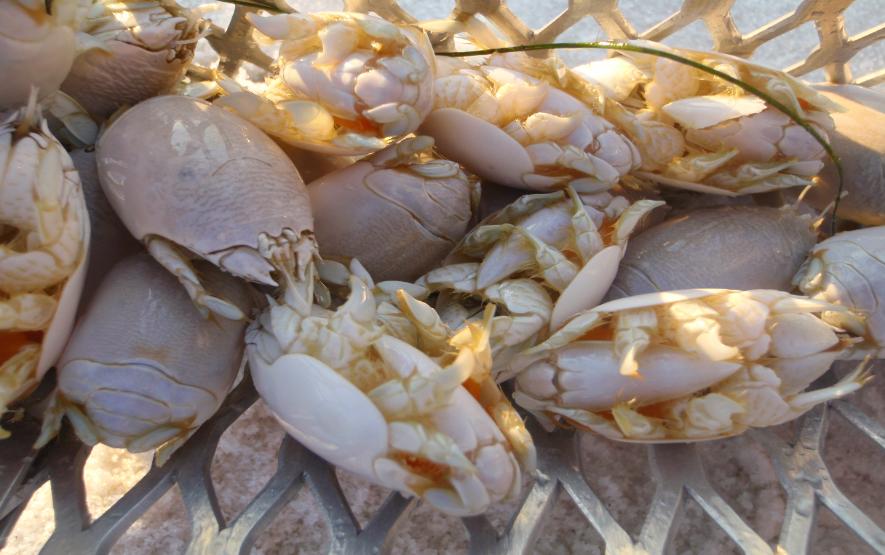
The sand fleas do not get very big - most are around a half inch to an inch long. The females grow up to 2 inches long while the males only grow up to about 3/4 inches long. Mole Crabs have five sets of "legs" on their underbelly. They are used primarily to paddle through the water and to dig into the soft sand. One characteristic of a Mole Crab is that they always travel backwards. They can walk on wet sand to get back to the water, but if they are put in dry sand, they usually will not move. They have no claws as most crabs have. Like other crabs, they "breathe" through gills and must have oxygenated water to live in. They can live out of the water for a few hours to a few days, depending on the temperature and if their gills do not dry out. Located on the rear of the underbelly is the crab's Telson. Locally it is referred to as the "digger". The telson has several purposes: 1) Helps to protect the soft underbelly of the crab. 2) Initiates digging by tactile stimulation of its base. 3) Anchors the sand flea in the sand once digging is complete. If you pull the telson away from a pregnant crab, you will find hundreds of brightly colored eggs underneath. During the reproductive season from February through October, one female can produce one clutch per month of 50-45,000 eggs, which take about 30 days to develop. There is a popular fisherman's belief that the orange eggs on a sand flea attracts pompano and other fish to the sand flea. This is why a lot of people like to use orange or pink colored pompano jigs. The eggs will turn brown shortly before they hatch. Studies have shown that they usually hatch just after sunset and when the waves or tide or high. It is thought that this timing helps to protect the eggs and the high tides assist in carrying them out to sea where they begin their life as free swimming zoea larvae. At sea they drift for 3-6 months and go through numerous developmental stages. As the larvae reach the juvenile stage, the currents begin to wash them up onto our beaches around March of each year. They are around 1/4inches long at this stage and are termed "recruits" by the biologist. They join the older sand fleas that have spent the winter buried deep in the sand near the shore. |




| --- Sand Flea Habitat ---- (swash zone) |
Mole Crabs (aka Sand Fleas) On the panhandle beaches, one bait that is prized by Destin's surf fishermen is the small crab that we call the Sand Flea. It is not actually a flea and will not harm you in any way. No claws and it does not bite. In other parts of the United States, it is referred to as a Mole Crab, Sand Crab, Beach Flea, Sand Bugs or a Sand Fiddler. It is a type of crab that lives in the wet sand at the water's edge of our beaches. Whatever you call it, the pompano, redfish, sheepshead, and other fish love it. |


Fishing Destin Guide©
A local's guide to fishing around Destin and the Florida Panhandle
A local's guide to fishing around Destin and the Florida Panhandle
Known as the "luckiest fishing village", Destin is the home to some of the best saltwater fishing in the United States. The 100 Fathom (600' depth) Curve of the Gulf of Mexico draws closer to Destin than any other spot in Florida. This, along with Destin's close proximity to the East Pass and the Gulf of Mexico, allows quick access to the Gulf of Mexico's fishing bounty. The purpose of this site is to acquaint a new fisherman to the Destin area - our local facilities, fish, waters and fishing methods. Tight lines and good fishing! |

Top view. It is facing to the left
SAND FLEAS (Mole Crabs) The small crustacean called the "Sand Flea" here in Destin and surrounding panhandle is what biologists call a decapod Crustacean. There are over 10 different species of this small crab located on the beaches throughout the world. The Gulf Coast's species are either Ermerita Talpoida or Emerita benedicti. (Talpoida means "mole like") I have no idea what the difference in the two species are and really don't think the fish care either. |

Rear View
Front of the flea.

| TELSON (digger) |
Bottom View - Facing Left
Side View - Facing Left
In late March or early April (Temperature related) of each year, they will start to form "colonies" in the "swash zone" of the beach. The bilogist are not sure why they do this but it is thought to have something to do with mating.
the wet sand as the waves wash up and down the beach. About every few minutes, they will extend two featherly "feeder" antennas to collect organic debris in a receding beach wave' This characteristic V shape wave each flea makes with its feeder antennas during the receding waves is the prime way to find the colonies. |


This web site is updated as I have time from other things going on. As there are a 1000 + different ways to do things, this is only my way of fishing, nothing else, and it is not the last word in fishing the area. I am by no means an expert but if you would like my opinion on something related to fishing the area, please email me at FishingDestinGuide@cox.net. It may take a few days before I get to it, so be patient. Thanks..... © Copyright 2014 Fishing Destin Guide All rights reserved |
To catch the sand fleas, you simply stand at the waters edge and look down the beach to the area where the water is running off the beach. You will see the tell tale Vs in the sand. Once you see them, run over in the dry sand above them, then wait for the next wave to come. As that wave goes out, run your scoop through the colony. Most people get a "sand flea rake" to catch them with. This is nothing more than a reinforced wire basket at the end of a handle. Lots of videos out there on You Tube and other places that show you how it is done. |
To hook a sand flea, just slide the point up from the bottom rear and out the top of the shell. A good You Tube for catching fleas: Catching Mole Crabs - 311Pope Check out his other videos tube, excellent information. |


Sand Fleas can be kept alive for several days. The key is to keep them damp and cool. If you are on the beach, keep them in a container with some damp sand. Keep it out of the sun by placing a wet towel over it. Rinse the sand every hour or so with fresh seawater. You do not want to keep them under water as they will consume the oxygen quickly like any other gilled animal and die. |

If you want to take them home with you, put them in a container and place them between layers of damp newspapers. In the refrigerator would be idea or in a cooler with some ice. Change or rinse the newspaper daily. After a few days, you should go ahead and freeze them. There are two thoughts on this: 1. Scald them in boiling water about 10 seconds, then put in a freezer bag. 2. Put them in a freezer bag with a mixture of salt and baking powder (equal proportions). Then place the bag in the freezer. Also if you use a vacuum sealer, the bait will keep longer in it |

Some tips in closing: The fleas wont always be in the colonies. Generally speaking, they travel a lot in the waves and the current in out area pushes them to the west. Also, they tend to migrate out to a few feet deep at times in scattered patches, so you may have to go wading for them You want to look for soft, waterlogged sand. A lot of times they will be found on what we call the "Lip". That is it area where the waves stop receding down the beach and is a small drop off (inches) between the sand of the beach and that that stays under water all the time. The fleas migrate up and down the beach too, usually moving up shoreward as the time comes in and moving seaward as the tides go out. |
In your search for the elusive Sand Flea (mole crab), you will run across other creatures. One crab, the Beach Mole Crab (Albunea paretii) is often called a "Male" Sand flea but is a totally different fellow. They make good bait but dont stay on your hook as good as the sand flea. |

The "LIP"
On one scoop I made, there were maybe 4-5 smaller crabs hanging on to a larger one. According to the bilogist, these are small males attracted to a larger female. Who knows, interesting though. |

OYes, people eat sand fleas, A good Google search will turn up several ways to do it. |